


Stucki’s plant in Lemont, Ill., recently purchased and installed a weld cell to improve the productivity and efficiency of railcar component manufacturing.
“The first part we’re using it for is a BOV handle kit, which prevents accidental opening of the bottom outlet valve on a rail tank car,” said CHRIS PROCHNOW, director of manufacturing and method engineering.
A weld cell is a self-contained system that automates the welding process by integrating software, a power source, a robotic arm and various safety features into a coordinated unit.
“We also plan to weld batten bars for trough hatch covers for our Mexico location, and over time we’ll add products like hex protectors, coil divider ends, seal pins and rings and chains,” said Chris.
The cell in Illinois was manufactured by Yaskawa, a Japanese firm. The unit’s accuracy, speed and dependability can’t be matched by humans, Chris said.
“Robots don’t take breaks and can maintain a steady pace, making them efficient and cost-effective,” he said.
“Once you get the welding speed, feed speeds and feeds set up properly, it will just reproduce that same weld over and over again.”
Seco Machine in Green, Ohio and Stucki’s Fremont, Neb., and Sharon, Pa., shops have utilized robotics in welding for several years.
Plans call for a weld cell to be installed at the Mexico plant by the end of the year, Chris said.
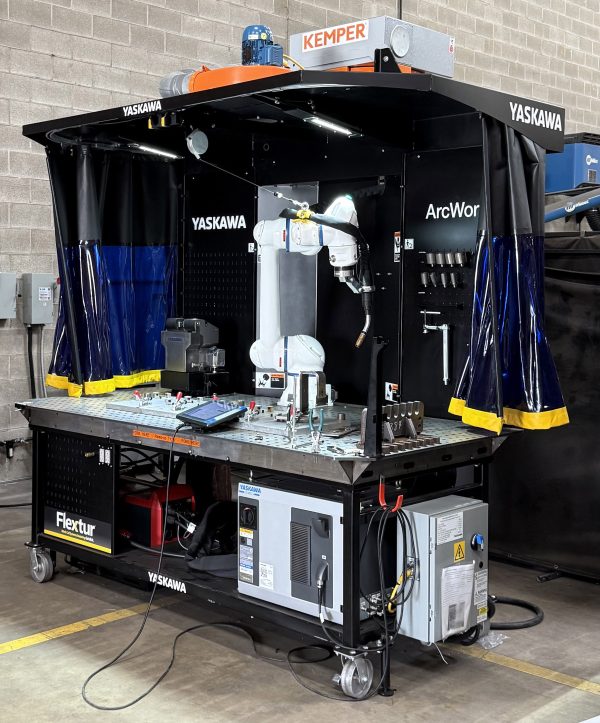
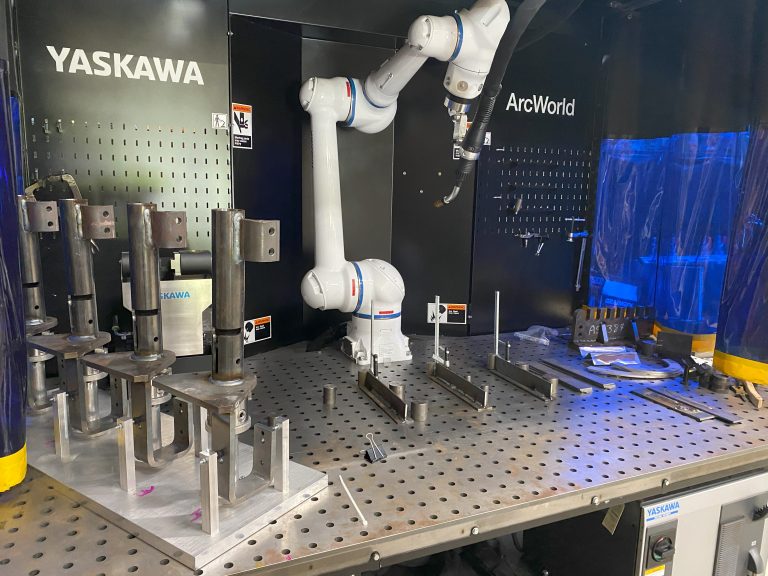
Left: A Yaskawa welding cell was recently installed at Stucki’s Lemont, Ill., plant. Right: A closeup view of the robotic arm.